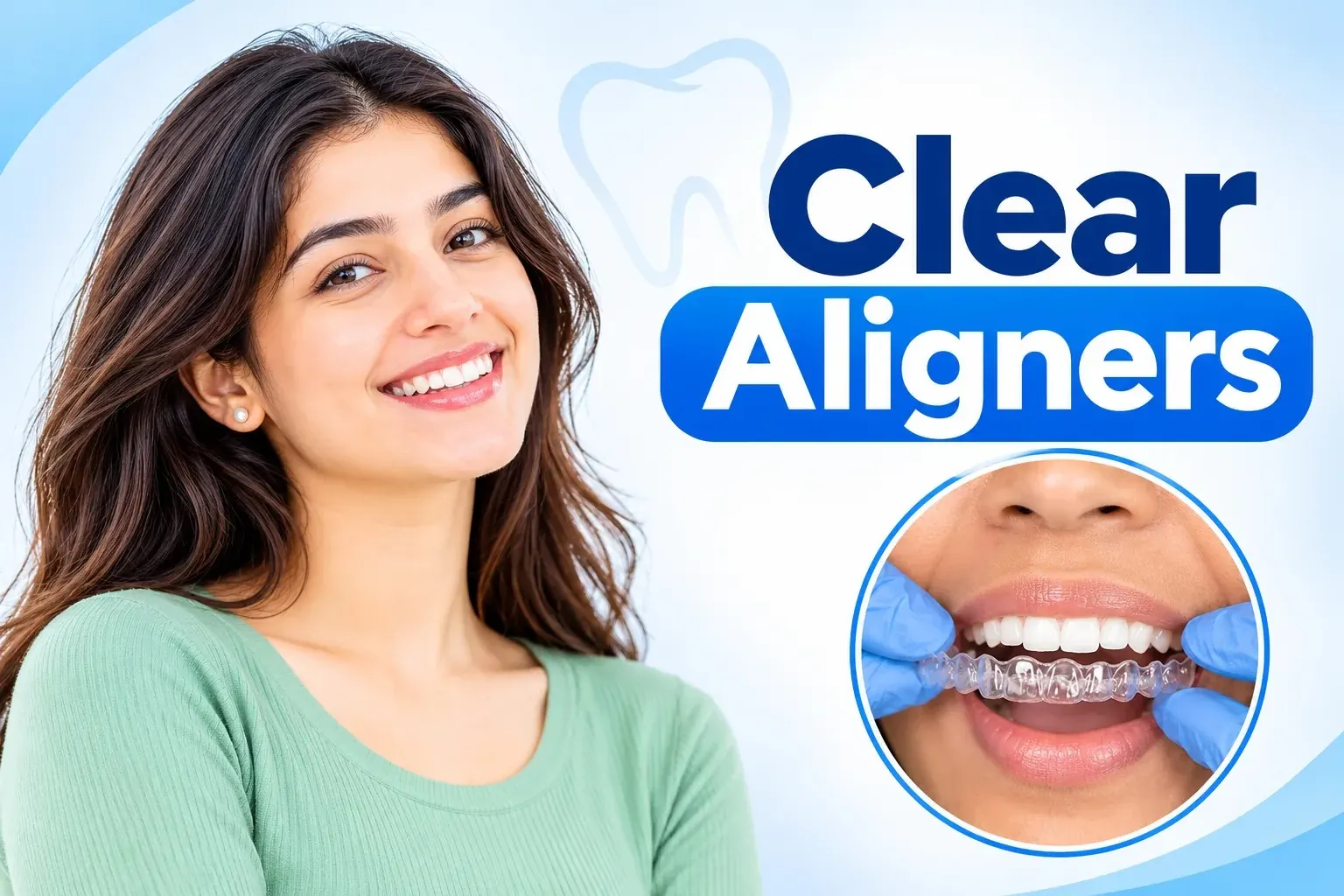

Clear aligners have changed how many adults and teenagers approach orthodontic treatment. They are removable, nearly invisible, and comfortable for most patients. That popularity has created a misleading impression: that aligners can fix any smile.
They cannot.
The honest answer to "Will aligners work for me?" depends on the type of problem, its severity, the patient's age, and above all-the patient's habits.
This article explains how aligners work, what they correct well, where they struggle, and how to judge whether they suit a particular case.
In This Article, You Will Learn
How Aligners Move Teeth: The biological mechanism of bone remodeling, attachments, and IPR.
What Aligners Correct Predictably: Mild-to-moderate crowding, spacing, and post-brace relapse.
Where Aligners Struggle: Skeletal jaw discrepancies, severe rotations, and large vertical movements.
Candidate Checklist: Who is an ideal candidate versus who needs traditional or surgical care.
Aligners vs Braces: How to choose the right appliance for lasting stability.
6 Critical Questions: What you must ask your orthodontist before beginning treatment.
How Aligners Move Teeth
Aligners are a series of custom-made plastic trays. Each tray shifts the teeth a small amount, usually a fraction of a millimetre per stage. Treatment is planned digitally from scans or impressions of the teeth. The clinician sets the target position and the sequence of movements before the first tray is made, and the patient moves to the next tray every one to two weeks.
Teeth move because sustained, gentle pressure triggers remodeling of the bone around the root. Bone is removed on the pressure side and laid down on the tension side. This takes time, and it cannot be rushed by wearing trays for fewer hours or changing trays early.
Three features matter clinically:
Attachments: Small tooth-coloured bumps bonded to certain teeth give the tray something to grip. Without them, movements such as rotation and root control are unreliable.
Interproximal reduction (IPR): A minimal, controlled polishing of the contact surfaces between teeth to create a little space when it is needed. It is done in measured amounts and only where enamel thickness allows.
Refinements: Teeth rarely end up exactly where the plan intended, so an additional set of aligners is often needed to finish the case.
Aligners work only if they are worn. Most protocols ask for roughly 20 to 22 hours a day, with the trays removed only for eating, for drinking anything other than water, and for cleaning.
What Clear Aligners Correct Well
Aligners are most predictable when the problem is mainly about tooth position rather than jaw position.
Mild to moderate crowding: Teeth that overlap or twist can usually be aligned, sometimes with IPR or modest expansion to create room.
Spacing: Gaps between teeth can often be closed efficiently, because moving teeth together is one of the more controllable movements for aligners.
Relapse after earlier braces: Adults whose teeth have drifted since previous treatment are frequently good candidates, because the movements needed are usually small and the case is often simpler than the original one.
Some bite problems: Mild deep bites, certain open bite patterns driven by tooth position, and dental crossbites can often be improved, though results depend on the case.
Aesthetic improvement of the front teeth: For people who mainly want straighter front teeth, aligners are often a reasonable choice, provided the back bite is acceptable and the expectations are realistic.
Cases that need hygiene-friendly treatment: Because trays come out, brushing and flossing are easier than with fixed brackets. This can matter for patients who struggle with plaque control around braces.
What Clear Aligners Struggle to Correct
Some problems are harder for aligners, and a few are better handled with another approach.
Significant skeletal discrepancies: When the upper and lower jaws are mismatched in size or position, tooth movement alone cannot correct the underlying problem. Severe overjets, underbites, and marked jaw asymmetries may need fixed appliances, functional appliances in growing patients, or, in some adult cases, a combination of orthodontics and jaw surgery. Aligners can sometimes camouflage a mild discrepancy by tilting teeth, but that is a compromise and should be discussed openly.
Large or complex rotations: Teeth that are close to round in cross-section, such as canines and premolars, are harder to rotate with a tray than teeth with flatter shapes. Severe rotations often need more attachments, more refinements, or brackets.
Bodily movement and large vertical movements: Moving a tooth with its root, rather than just tilting the crown, is more demanding. Extruding teeth, which means pulling them down into the bite, is also less predictable.
Severely tipped or impacted teeth: Teeth that are far out of position, or that have not erupted, often need brackets, sometimes with surgical exposure.
Large gaps and extraction cases: Aligners can close extraction spaces, but the planning is complex, and control of tooth angulation during space closure is a known challenge. These cases need careful monitoring.
Poor compliance: This is a limitation of the patient, not the appliance, but it matters most. A removable aligner that stays in its case does nothing, and a plan that depends on 22 hours of wear will fail for someone who cannot commit to it.
Who Is a Good Candidate, and Who Is Not
The best candidates tend to share a few traits: healthy gums and teeth, a problem that is mainly dental, enough discipline to wear the trays, and expectations that match what the appliance can deliver.
Patients who may need a different plan include:
Teenagers whose jaws are still growing and whose problem is skeletal, where timing of treatment matters more than the choice of appliance.
Patients with active gum disease, untreated decay, or loose teeth, who need those conditions managed first.
Patients whose bite problem is mainly in the jaws rather than the teeth.
Patients who are unlikely to wear the trays consistently, for whom fixed appliances may be more reliable.
A candidate who is "not suitable for aligners alone" has not been refused treatment. It means a different or combined approach will probably give a better result.
Factors Beyond the Tooth Movement
A good plan looks beyond the crooked teeth themselves.
Gum and bone health: Orthodontic movement in the presence of active periodontal disease can cause harm. Gum health should be stable before treatment starts and monitored throughout.
Existing dental work: Crowns, bridges, and implants do not move, and smooth restored surfaces can limit where attachments hold. Planning has to account for what cannot shift.
Habits: Tongue thrusting, nail biting, mouth breathing, and teeth grinding can affect results and relapse risk. Some of these need to be addressed alongside the aligners.
Wisdom teeth and growth: Where the back teeth sit and whether wisdom teeth are present can influence how much space is available and how stable the result will be.
Retention: Teeth tend to move back after treatment. Retainers are part of the plan, not an optional extra, and many patients need them long term.
📋 What Treatment Is Actually Like
Patients are often surprised by the everyday reality.
Mild soreness for the first few days of each new tray is common and usually settles. A slight lisp may appear at the start and generally fades within days to a couple of weeks as the tongue adapts.
Trays must be cleaned daily and stored in their case-never wrapped in a tissue, because that is how many get accidentally thrown away.
Regular review visits matter. During them the clinician checks whether the trays are tracking, meaning that the teeth are moving as planned, and whether attachments are intact. If the fit is poor, treatment is adjusted early rather than allowed to drift off course.
⚖️ Aligners Versus Braces
Braces are not outdated. For complex rotations, significant bite correction, and cases needing precise root control, fixed appliances remain highly effective, and in many cases they give the clinician more control.
Aligners offer comfort, appearance, and easier hygiene. Braces offer constant wear that does not depend on the patient's discipline.
The better question is not "aligners or braces?" but "which appliance, or which combination, gets this particular patient to a stable, healthy result?" Some cases are treated with a hybrid approach, using brackets for part of the movement and aligners to finish.
💡 Common Myths
"Aligners are faster than braces."
Not reliably. Treatment time depends on the complexity of the case and on compliance, not on the appliance type."Aligners are only for mild cases."
Not true either. Many moderate cases do well, and well-selected complex cases can be treated, but complexity raises the chance of refinements and the need for adjuncts."Once the aligners come off, I'm done."
Without retention, relapse is likely. Retention is the final phase of treatment, not an add-on."Cheaper, mail-order aligners are the same thing."
A clinician-led process includes a full examination, radiographs, and an assessment of gum health and bite. Skipping those steps removes the safeguards that identify unsuitable cases.
❓ Questions to Ask Before Starting
Is my problem mainly dental, or does it involve the jaws?
What will the aligners realistically achieve, and what will they not?
Will I need attachments, IPR, or refinements?
How long will treatment take, and what will retention involve?
How will progress be monitored, and how often will I be seen?
If aligners are not predictable for my case, what is the alternative?
🛡️ Why Supervision Matters
Direct-to-consumer and unsupervised aligner services skip steps that matter, such as a full clinical examination, radiographs, and an assessment of gum health and bite.
A trained orthodontist can recognize when a case is outside what aligners can reliably deliver and say so before treatment begins. Supervision also means someone is checking tracking, managing complications, and adjusting the plan as the teeth respond.
Whichever clinician you choose, always ask for a complete clinical diagnosis and tailored treatment plan before committing to an appliance.
📌 Key Takeaways
Aligners work best for mild to moderate crowding, spacing, relapse, and selected bite problems.
Skeletal discrepancies, severe rotations, and complex movements may need braces or combined treatment.
Success depends on wearing the aligners consistently (20–22 hours daily) and following the retention plan.
Gum health, existing restorations, and oral habits all influence the outcome.
A proper diagnosis should come first, and the appliance second.